
Don't Fix the Typhoon in Playschool

Updated: Apr 27
My son is 20 months old.
He is, to put it scientifically, a chaos engine in a diaper. The kid has figured out that the gap between the sofa and the wall is a perfect hiding spot when he does not want to go to bed.
He once spent forty minutes arranging and rearranging a set of spoons on the floor with the focus of a surgeon and the satisfaction of an artist. He does not know what "impossible" means yet, and I am in no hurry to tell him.
My wife and I talk about his education a lot. Not which school, not which board, not which coaching class at age four. We talk about the how. How do we keep the spoon-arranging curiosity alive? How do we make sure that chaos feels like a superpower and not a character flaw? How do we teach him to take a fall, get up, grin, and try an even worse idea next time?
Those are the conversations that keep us up at night, in the best possible way.
Which is exactly why a recent "fun event" at one of the largest playschool chains in India left me with something I can only describe as a low-grade, lingering anxiety. The kind that does not announce itself loudly. It just sits there, behind the sternum, quietly insisting that something is wrong.
The Event
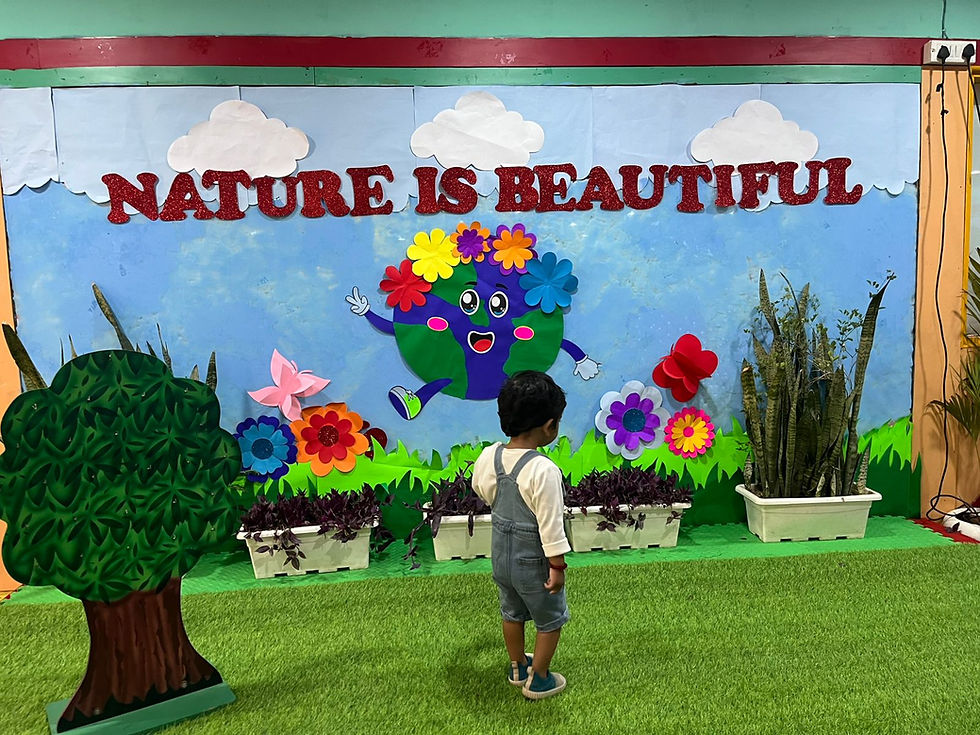
In business terms, it was a lead generation event. Smartly packaged as a fun afternoon for toddlers and their parents. The space was colorful, the staff was warm, and there was a genuine effort to make it feel like a celebration of childhood.
But then I started watching. Really watching. And I could not unsee what I saw.
There was a painting activity. Kids were dipping their hands in color, which was lovely. But they were being taught the "right" way to place that painted hand on the paper. The exact angle. The exact spot. To make a "perfect" tree. The teachers were patient and kind. But the subtext was impossible to miss. There is a correct output. Let me show you how to produce it.
A child, maybe two years old, got up from his chair mid-activity and walked closer to the front where an animal puppet show was happening. He sat down on the floor, cross-legged, absolutely transfixed. It was the purest moment of joy in the room. He was so obviously, completely happy.
He was gently escorted back to his chair.
After the painting was done, aprons on, hands washed immediately. Because otherwise, it makes your clothes and surroundings dirty.
Everyone was polite. Everything was organized. And I felt deeply, genuinely uncomfortable.
What Was Actually Happening
I want to be fair here. The people running this event were not villains. They were doing exactly what the system was designed to do. The system just happens to be optimized for the wrong thing.
The output this system is building toward is a child who sits straight, follows instructions, produces the expected result, and does not create mess or inconvenience for the adults around them. A little gentleman. A little ma'am. Presentable. Manageable. Predictable.
And here is the part that genuinely bothers me: that is also exactly what most parents secretly want, even when they say they don't. Because a manageable child is easier to live with than a typhoon. A child who colors inside the lines gets praised. A child who colors the table, the floor, their friend's face, and themselves is a problem to be solved.
We say we want curiosity. We reward compliance.
We say we want fearlessness. We teach caution at every edge.
We say we want original thinkers. We correct them the first time they think differently.
And we start this at twenty months.
What Childhood Is Actually Supposed to Feel Like

I grew up on Rugrats. If you know, you know. If you don't, Rugrats was a cartoon about toddlers who operated with complete autonomy, boundless imagination, and zero understanding of why adults were so obsessed with keeping things tidy. They were not bad kids. They were just completely, unapologetically alive.
That is the image in my head when I think about what childhood should feel like.
Messy. Loud. Full of schemes that make no logical sense but feel like the best idea anyone has ever had. Scraped knees as a natural consequence of operating at full speed. Paint on the t-shirt, on the wall, possibly on the dog. A chipped tooth worn like a badge of honor.
The afternoon where nothing productive happens and two kids are just lying on the floor staring at the ceiling fan and giggling for no apparent reason? That is not wasted time. That is the operating system being built. The one that will later be able to sit with ambiguity, generate ideas from nothing, and find joy in the process rather than just the outcome.
Boredom is the mother of invention. Mess is the evidence of effort. Chaos is just curiosity without a project manager.
When you over-supervise all of that, when you route every instinct through a template and a lesson plan, you are not building a child. You are building a very small adult who has already learned to suppress the most valuable parts of themselves.
What a Brave School Would Actually Look Like
I have thought about this more than is probably healthy for a person with a full-time job. But since I am also wired to turn problems into product specs, here is what I would build.
The day would be so full of things the kids actually love that the iPad would stop being a temptation. Not because screen time is banned, but because why would you choose a screen when you have paint and mud and a friend to conspire with?
The "report card" at the end of the year would be the t-shirt. Literally. Every mark, every stain, every color tells a story of something attempted. Something made. Something felt. Frame it. Put a date on it. That is a souvenir worth keeping.
Learning would be constant but not scheduled on a per-hour basis. You do not tell a river when to flow. You build the terrain and get out of the way.
The metric would not be "Did the child follow instructions today?" It would be "Did the child ask a question today that we could not answer?" Because that is the one that matters.
There would be no right way to draw a tree. The tree with six trunks and purple leaves drawn by a child who was simply not paying attention to realism is more interesting than the technically correct one every single time.
And the child who sits on the floor because he wants to be closer to the puppet show? He stays on the floor. You sit with him.
The Question I Cannot Shake
I know it is possible to raise a child this way. We have been doing it, one messy, joyful, exhausting day at a time. Not perfectly, not by a long shot. But with a clear north star.
The question is not whether it is possible. The question is whether enough people actually want it.
Because here is the uncomfortable truth. Most of us grew up in the other system. The chair system. The right-answer system. The apron-on-hands-washed-immediately system. And a lot of us turned out fine. Or at least, functional. And so there is a deep, quiet voice in many parents that says, "It worked for me. Maybe it is not so bad."
That voice is wrong, but it is understandable.
And on the supply side, I genuinely want to know: is there a school in India right now that is brave enough to build this? Not brave in a marketing brochure sense. Actually brave. The kind of brave that means you call a parent and say, "Your child had an incredible day, he painted himself from head to toe and refused to stop laughing" and you mean it as high praise.
Because the children who get to be typhoons today are the ones who will, in twenty years, be entirely unafraid of the kind of problems that make everyone else sit very straight in their chairs and wait for someone to tell them the right answer.
I am raising one of those typhoons. I would very much like to find a school that is not trying to turn him into something more manageable.
If you are building that school, or know someone who is, please reach out. We have a lot to talk about. If not, then maybe brainstorm or build it together? Because I feel there is nothing more critical than building curious, thinking individuals.

